
Your SDLC, run by agents,
governed by you.
Run Claude Code, Codex, Gemini, and more in isolated containers on your own infrastructure. Every change moves from idea to merged pull request through approval gates, second opinions, spend caps, and signed audit receipts. Plan with frontier models, then execute on the subscriptions or local models you already have.
git clone https://github.com/gitseed-dev/gitseed.git && cd gitseed && make init && docker compose up -d --build
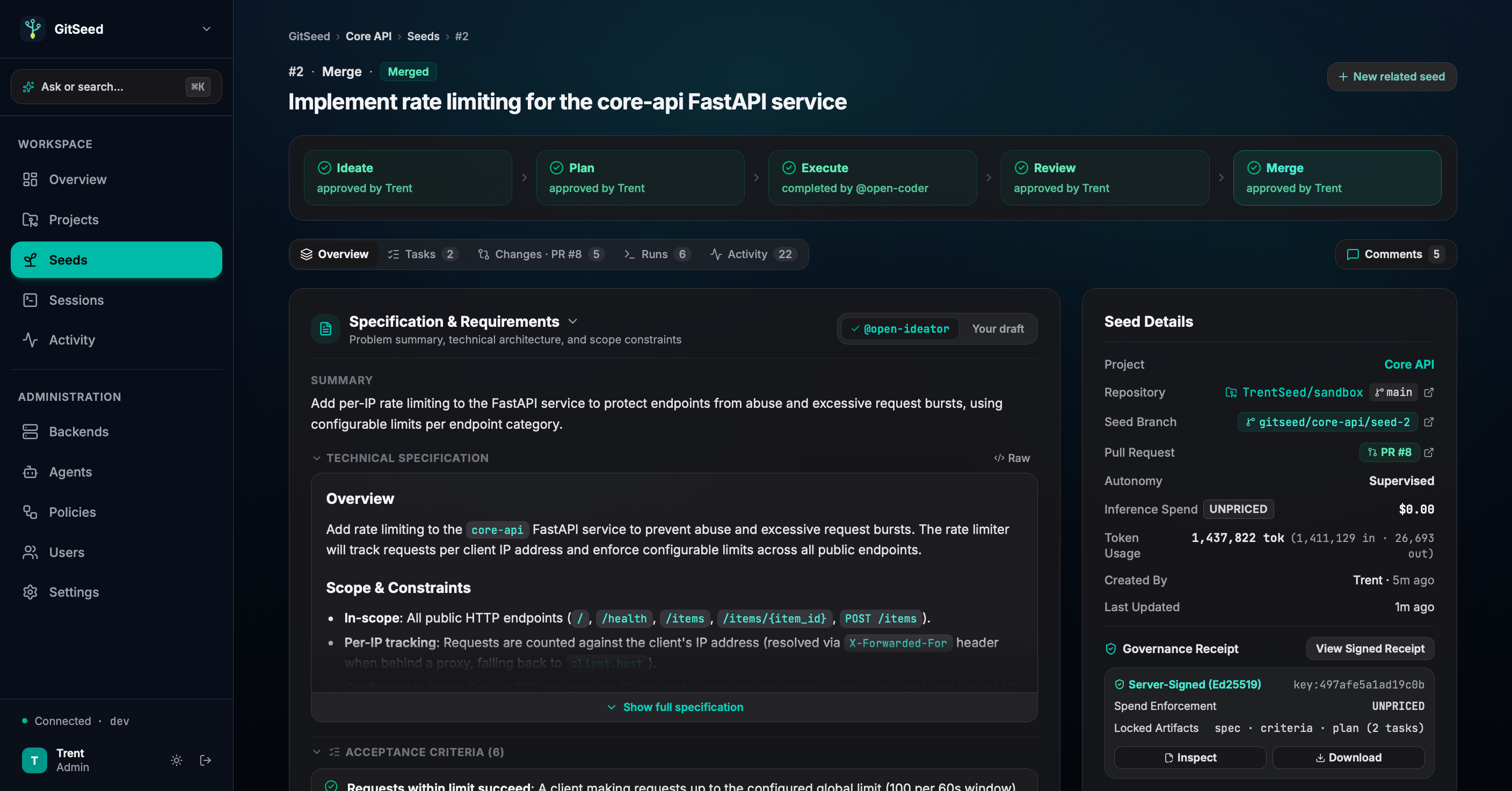
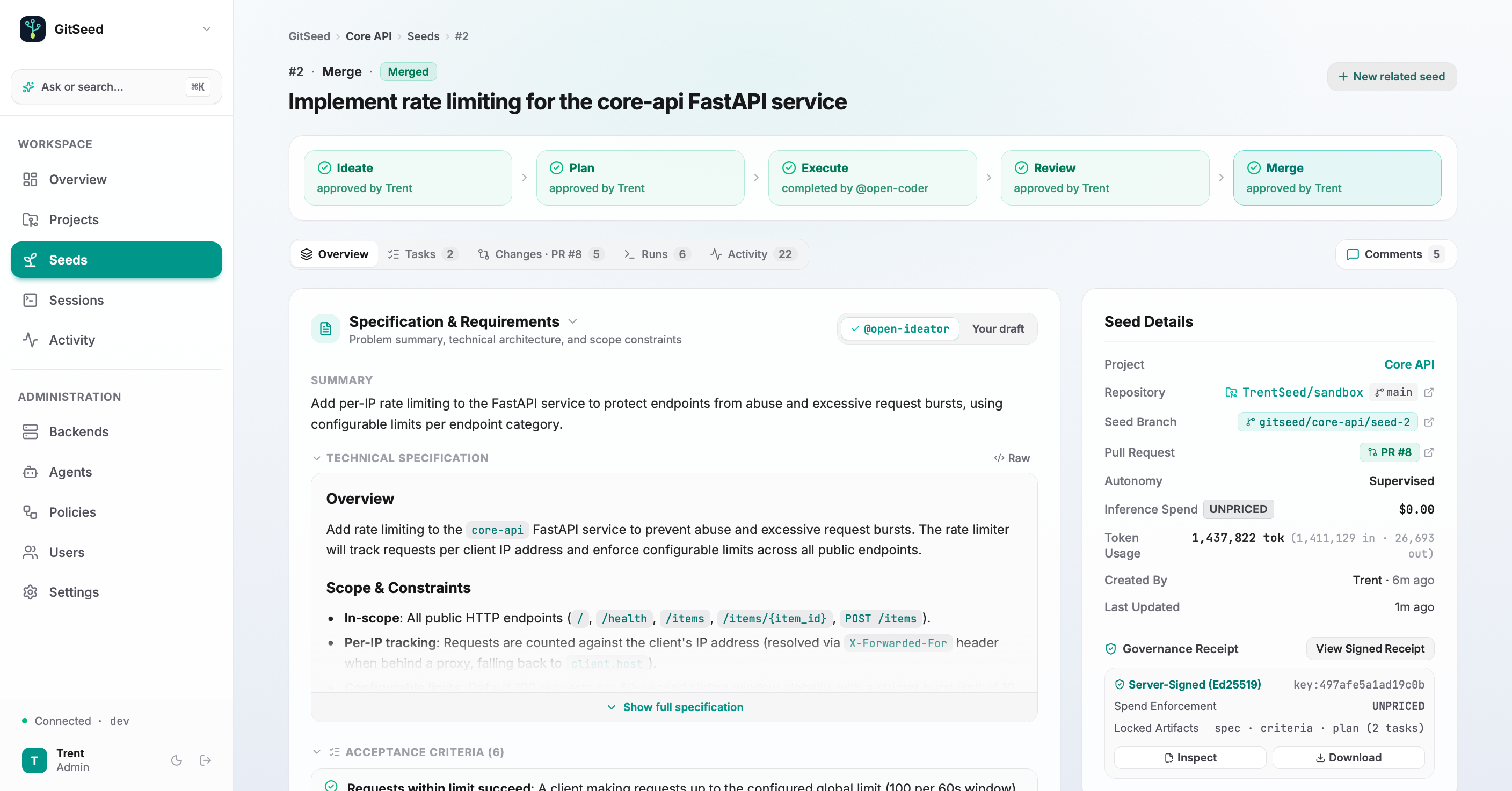
On every device Coming soon
Native companion apps for desktop, phone, and watch. Get notified below when builds drop.
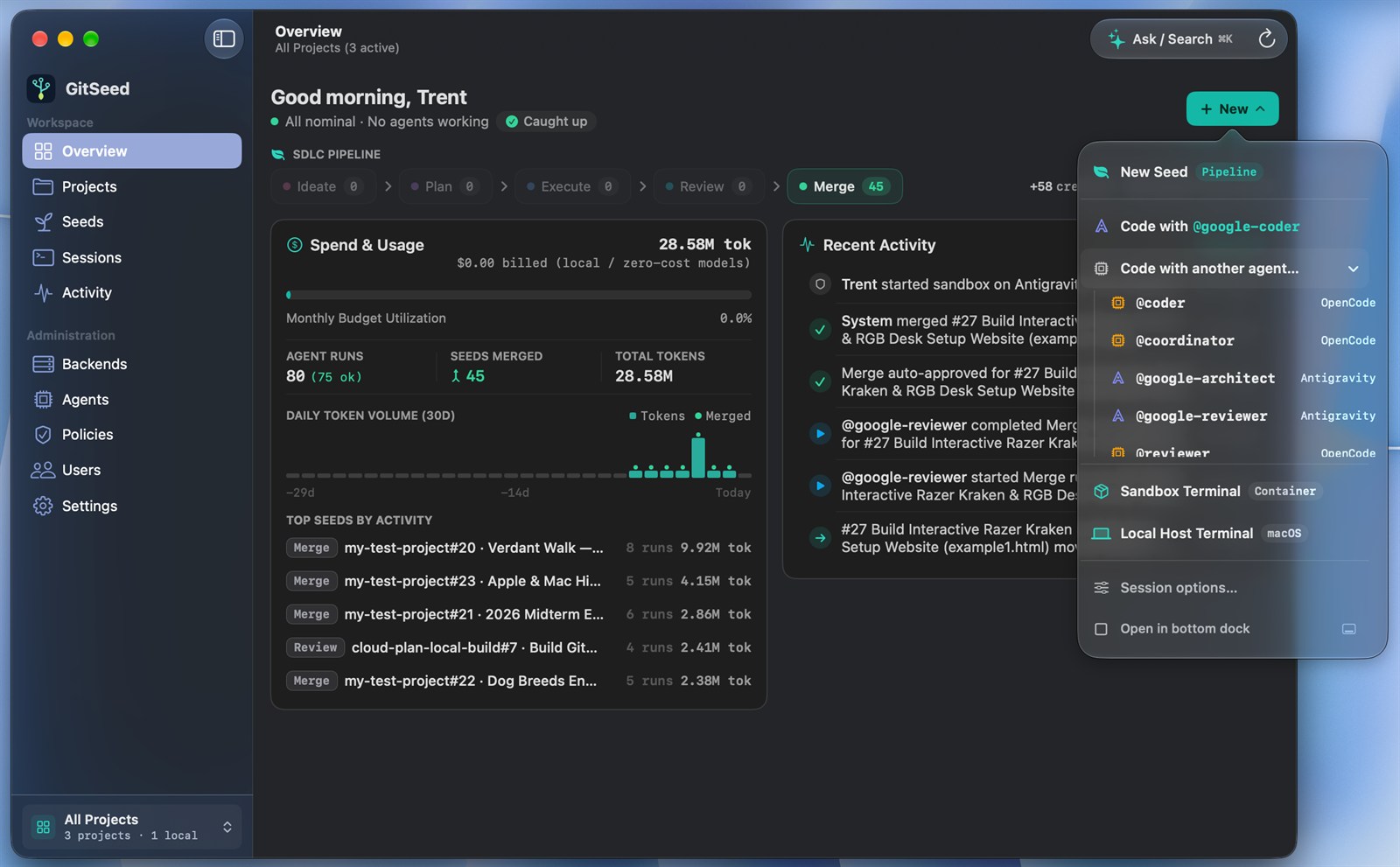
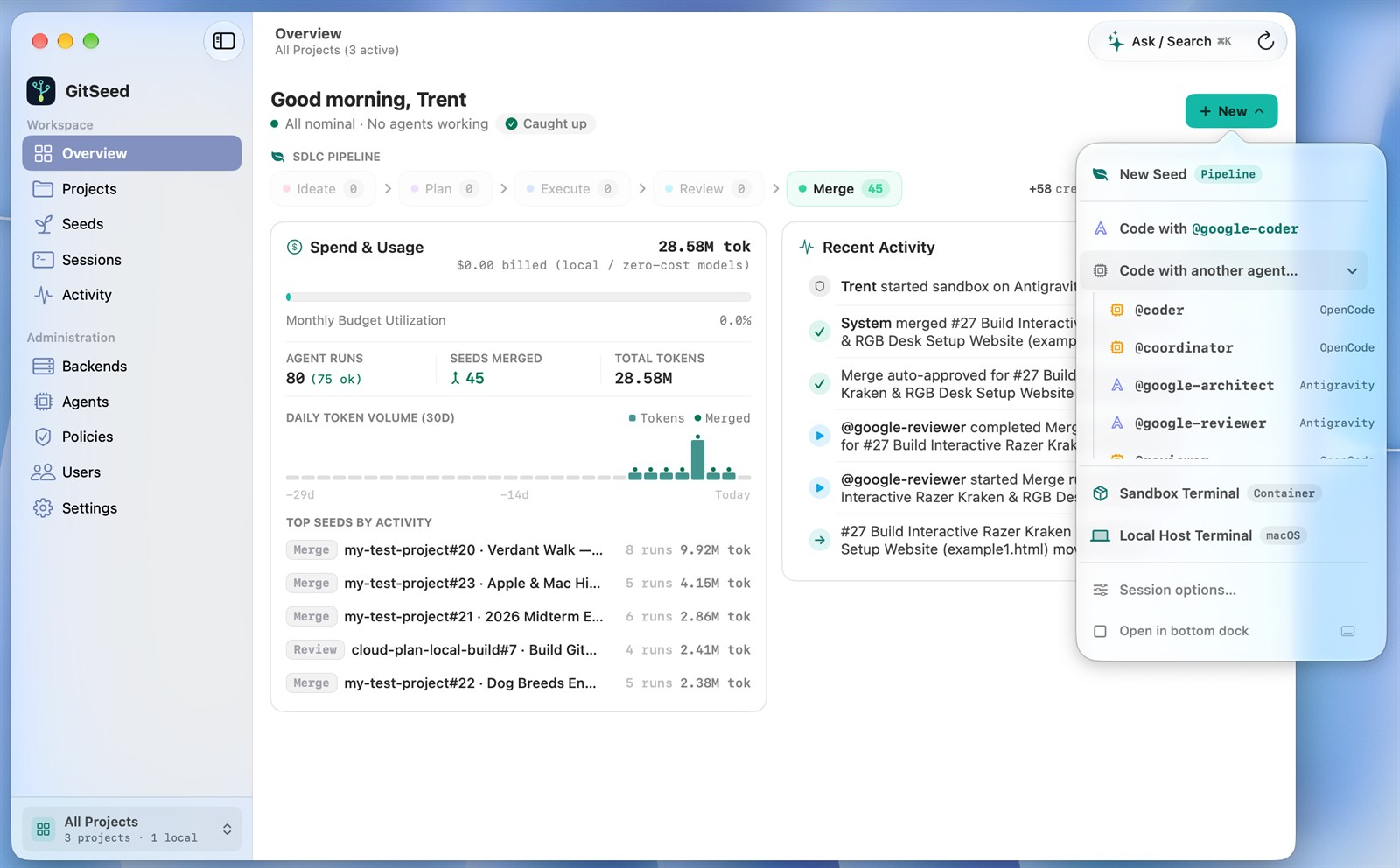
Desktop · Sessions, VS Code, and dispatch
Phone · Approve gates and checkpoints
Watch · Needs-you alerts, one-tap approve
From requirement to merged pull request
A Seed moves through five structured stages, or jumps straight to code with Fast-Track. Select any stage below to see what the agent does and where you sign off.
Clarifies problem scope and constraints before planning begins.
Analyzes the seed prompt, attachments, and repository context to refine requirements and surface testable acceptance criteria.
Compare drafts from one or more agents, edit your chosen starting point, and approve to lock the specification for downstream stages.
Features & self-hosted architecture
Untrusted-agent container isolation, Ed25519-signed provenance receipts, and transparent spend controls on your own infrastructure.
How a Seed runs on your infrastructure
Every request flows from your client surfaces through the control plane into isolated, zero-credential agent containers.
Untrusted Agent, Trusted Broker
Every stage splits into prepare, agent, and finalize containers.
Agents hold zero Git credentials; a read-only finalize broker commits via a clean
.git directory, enforces blocked_paths, and scans diffs for secrets.
Signed Governance Receipts
Every PR receives an Ed25519-signed gitseed.receipt.v1 receipt attesting to the locked
spec, models, spend mode, blocked_paths checks, and human approvals, verifiable via
gitseed receipt verify.
Parallel 3-Model Second Opinions
Dispatch up to three different agents in parallel during Ideate, Plan, or Review to compare competing
specs and aggregate @reviewer findings side-by-side.
Personal Mode OAuth, Team APIs & Local GPUs
Use owner-bound Personal Mode with your Claude, ChatGPT, Gemini, or Antigravity subscription, route team
APIs through LiteLLM, or run air-gapped on Ollama and vLLM. Five agent CLIs come pre-installed on local
builds, plus a grok-build adapter.
Enforced vs. Estimated Spend Controls
Enforce hard per-run LiteLLM virtual-key dollar caps in API mode (enforced), or track token
telemetry bounded by broker wall-clock timeouts and --max-turns in Personal Mode
(estimated).
Docked VS Code, Self-Healing CI & Local Git
Drop into any live sandbox via browser PTY or cookie-isolated VS Code Web, steer @coder
from GitHub/GitLab PR comments, auto-remediate failing CI, or sync local folders.
How GitSeed compares
Self-hosted container isolation and signed PR receipts vs. local worktree wrappers and hosted agent bots.
| Dimension | Local Worktree Wrappers | Hosted SaaS Agent Bots | GitSeed |
|---|---|---|---|
| Compute & Isolation | Host OS worktrees (shares host files & creds) | Vendor-hosted VMs | ✓3-phase prepare/agent/finalize broker; zero agent Git creds |
| Auth & Models | Local CLIs only | Vendor credits & models | ✓Team LiteLLM APIs, single-user Personal Mode OAuth & local Ollama/vLLM |
| SDLC & Opinions | Ad-hoc parallel prompts | Single-stage agent loop | ✓5-stage or Fast-Track + 3-model second opinions |
| Provenance & Receipts | Local terminal scrollback | Opaque vendor logs | ✓Ed25519-signed PR Governance Receipts |
| Spend & Governance | Passive token counters | Shared seat billing | ✓Enforced LiteLLM caps, Estimated Personal telemetry & role gates |
| Surfaces & Rescue | Desktop split terminals | Web chat ticket portal | ✓Web UI, CLI/TUI, MCP server & docked VS Code |
Command Line, TUI & MCP
Sync seeds from repo files, steer running agents, approve gates, or verify signed governance receipts.
Security & Self-Hosting FAQ
Key answers for engineering teams running GitSeed on their own infrastructure.
How are untrusted coding agents isolated?
Every stage run splits into prepare → agent → finalize containers behind
docker-socket-proxy and an SSRF-hardened egress-proxy. The agent
container runs non-root with CapDrop: ALL and zero Git credentials; the trusted
finalize container mounts /workspace read-only (:ro), commits
into
a
clean .git directory, enforces blocked_paths, and scans added lines for
secrets.
How do Enforced vs. Estimated spend controls work?
In API / LiteLLM mode, the scheduler provisions per-run virtual keys with hard
proxy-enforced
dollar ceilings (enforced). In single-user Personal Mode (subscription
OAuth),
CLIs talk directly to vendor endpoints, so USD spend is estimated from CLI token telemetry
and
bounded by broker-enforced wall-clock timeouts and --max-turns.
What is a Signed Governance Receipt?
Every Pull Request receives a canonical gitseed.receipt.v1 JSON bundle signed with your
control
plane’s Ed25519 key. It attests to the locked spec, models, trusted diff & secret-scan
verification
(run.output["trusted"]), budget enforcement mode, and human stage
approvals, verifiable
via
gitseed receipt verify.
Where are secrets stored and what leaves my network?
Startup fails closed unless make init generates high-entropy secrets. Credentials are
encrypted
at rest using HKDF-SHA256 + MultiFernet (AES-128-CBC + HMAC-SHA256). The
GitSeed Control Plane, Runner, Web UI, CLI, and MCP Server are 100%
Apache 2.0 open source, send zero telemetry, and can run 100% air-gapped with
OpenCode + local Ollama or vLLM.
Run GitSeed on your machine in five minutes
Generate secrets with make init, build & start Docker Compose, then open http://localhost:8421.
git clone https://github.com/gitseed-dev/gitseed.git && cd gitseed && make init && docker compose up -d --build
Stay in the loop. Get release notes and major updates. No spam, unsubscribe anytime.